Friday, December 20, 2013


Monday, July 8, 2013
Project Glass Explorer Program Pickup
It all started with a invitation from Google to post on Google+ or on Twitter how you would use Glass if you had the opportunity to get a pair from Google. It was a great way for Google to judge the demand that they had for the wearable device long before it was released and even before many knew anything about it. I had only seen one video and a couple of pictures taken by employees at Google. The video that I saw was this one:
All that was asked what that you post with the hashtag #ifihadglass. I didn't waste anytime at all and quickly thought about things that I would do. The obvious choice for me was something on the DigitalChalk platform. Here is what I responded with:

After that, I really forgot about it until the Twitter account of Project Glass (@projectglass) responded to me a little over a month later letting me know that I was chosen to be a part of the program.
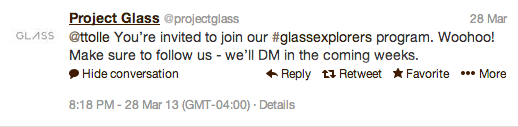
I was certainly excited to see that and then the wait began. I waited for 3 months before hearing from Project Glass again. I started to wonder if maybe they had eliminated me as a participant or even forgot about some. Then, on June 21st I got a direct message from them that invited me to schedule my pickup in New York City. That night I went online, ordered Glass and booked my plane tickets.
This past weekend, I flew to New York to pick them up. We were able to invite one person to go with us to the pickup and I asked my brother-in-law to go since he lives in New York near the city. We met at Starbucks across the street in Chelsea Market and then walked over the Google offices where the pickup for Project Glass was located. We were greeted as soon as we got off of the elevator by two people in reception wearing Glass and they checked us in and gave us guest badges marked with Explorer Edition.
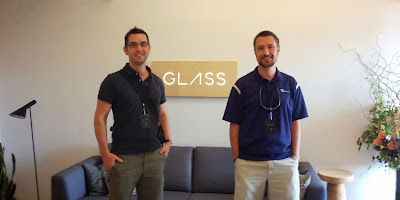
After a very brief wait, we were met by our Glass Guide, Sunil who was awesome. He took us back to his station and then let us try on all of the different colors of Glass. Even though I had specified the color online when I purchased them, he asked if I would like to switch.

I chose to stick with Shale and by the time we got back from the fitting station, someone had brought a new box to the desk with a Shale pair of Glass. After a quick chat, I proceeded with the unboxing and Sunil let me through fitting them to my face and then through the basic setup of connecting them to my phone and to the wireless network. The phone is connected through Bluetooth pairing and connecting to the wireless network was made easy by inputing the connection information in my glass profile online and then scanning a QR code with my Glass to configure them.
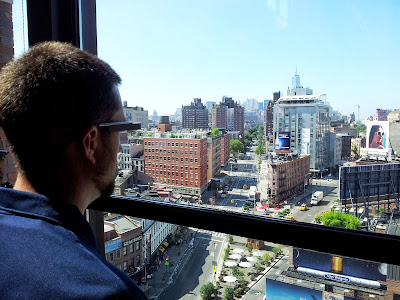
Sunil then let me up on to a platform overlooking the New York City skyline, complete with the Freedom Tower in the distance. Here he taught me how to take pictures and video in different ways and how to perform a Google search with Glass.

I can't wait to see what the future holds!
All that was asked what that you post with the hashtag #ifihadglass. I didn't waste anytime at all and quickly thought about things that I would do. The obvious choice for me was something on the DigitalChalk platform. Here is what I responded with:
After that, I really forgot about it until the Twitter account of Project Glass (@projectglass) responded to me a little over a month later letting me know that I was chosen to be a part of the program.
I was certainly excited to see that and then the wait began. I waited for 3 months before hearing from Project Glass again. I started to wonder if maybe they had eliminated me as a participant or even forgot about some. Then, on June 21st I got a direct message from them that invited me to schedule my pickup in New York City. That night I went online, ordered Glass and booked my plane tickets.
This past weekend, I flew to New York to pick them up. We were able to invite one person to go with us to the pickup and I asked my brother-in-law to go since he lives in New York near the city. We met at Starbucks across the street in Chelsea Market and then walked over the Google offices where the pickup for Project Glass was located. We were greeted as soon as we got off of the elevator by two people in reception wearing Glass and they checked us in and gave us guest badges marked with Explorer Edition.

After a very brief wait, we were met by our Glass Guide, Sunil who was awesome. He took us back to his station and then let us try on all of the different colors of Glass. Even though I had specified the color online when I purchased them, he asked if I would like to switch.

I chose to stick with Shale and by the time we got back from the fitting station, someone had brought a new box to the desk with a Shale pair of Glass. After a quick chat, I proceeded with the unboxing and Sunil let me through fitting them to my face and then through the basic setup of connecting them to my phone and to the wireless network. The phone is connected through Bluetooth pairing and connecting to the wireless network was made easy by inputing the connection information in my glass profile online and then scanning a QR code with my Glass to configure them.
Sunil then let me up on to a platform overlooking the New York City skyline, complete with the Freedom Tower in the distance. Here he taught me how to take pictures and video in different ways and how to perform a Google search with Glass.

We then returned to our station and Sunil answered a few more questions and showed me how to make phone calls and share activity from Glass. The entire appointment only lasted about an hour and fifteen minutes but a lot of ground was covered. It was time to return our badges and hit the streets of New York with them on.
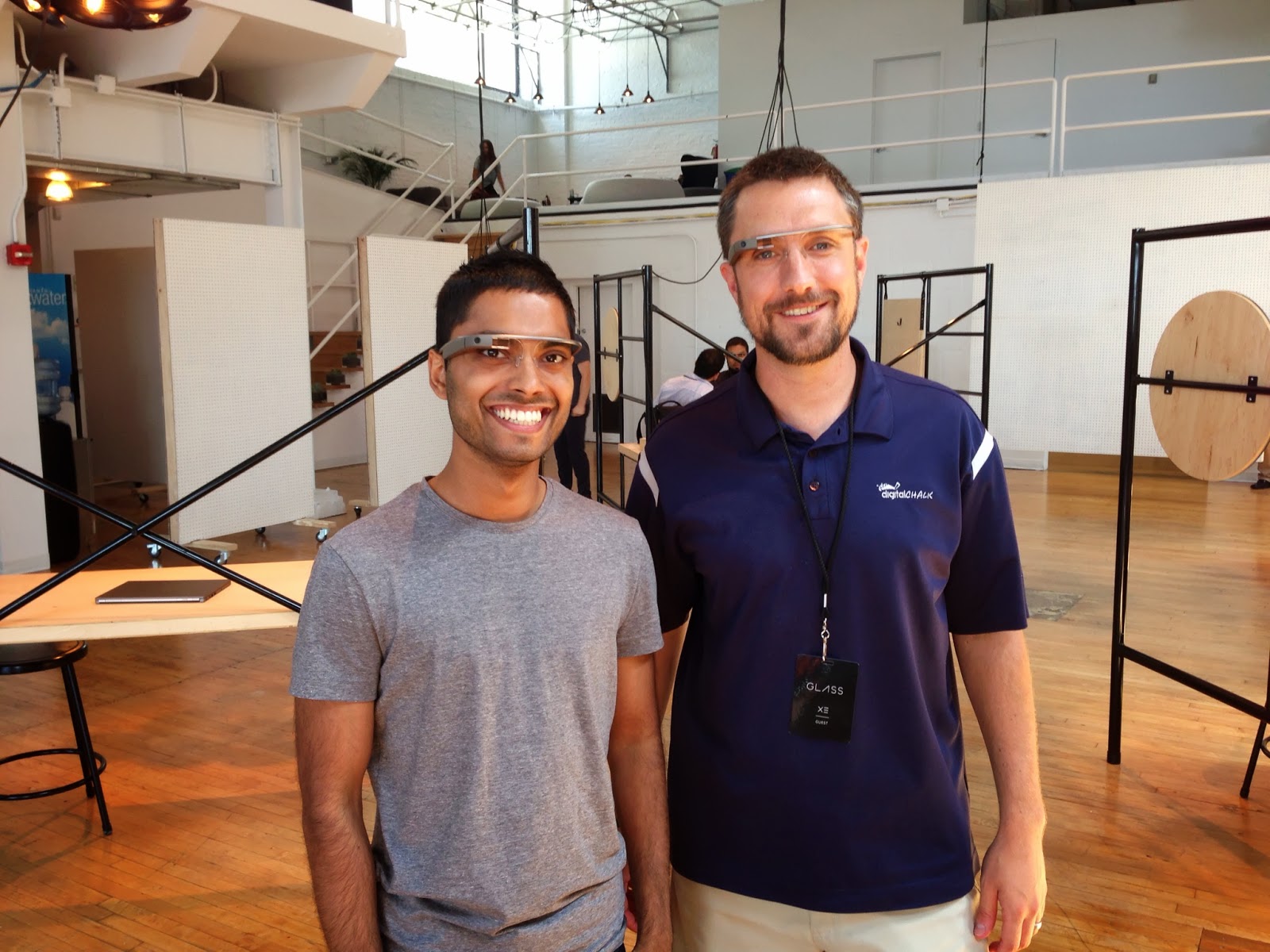
It was odd leaving the building with this device on my head, but it quickly became less and less noticeable to me. I have had them for two days now and have worn them to church and to work. One of the great things about wearing them around is letting kids try them out when they ask. The excitement on their faces is so evident. They almost always start laughing and smiling. It is great to watch and be a part of opening up a whole new world to them. I think this will certainly be a part of their future. There are not that many applications right now written for them, but as they become available, the use for Glass will only grow and become more embedded in our lives. I feel fortunate to have the ability to be one of the few able to test these out and write some applications for Glass. If you would like to follow me on Google+, that is where I will most likely be sharing most of the pictures and videos that I take with Glass, you can do so here:
I can't wait to see what the future holds!
Tuesday, January 1, 2013
Tuesday, December 25, 2012
Merry Christmas
POST /broadcast HTTP/1.1
Host: cloudchamp.com
Content-Type: application/json;charset=UTF-8
Content-Length: 176
{
"author": "Troy",
"content": "Merry Christmas! Remember the reason for the season. \u003ca href=\"http://bible.us/116/luk.2.1-20.nlt\"\u003eLuke 2\u003c/a\u003e"
}
Host: cloudchamp.com
Content-Type: application/json;charset=UTF-8
Content-Length: 176
{
"author": "Troy",
"content": "Merry Christmas! Remember the reason for the season. \u003ca href=\"http://bible.us/116/luk.2.1-20.nlt\"\u003eLuke 2\u003c/a\u003e"
}
Tuesday, July 3, 2012
Happy 4th of July
Independence Day is one of my favorite holidays. I can't help but smile and fill with pride when I see the red white and blue of the flag go up in store windows, street corners, and on the front porches of so many homes. It is a feeling of strength, of pride, of gratitude and humility all neatly wrapped into one. It is a feeling that warms the heart and the soul. It is hamburgers and hotdogs, fireworks and swimming pools, parades and homemade apple pie and ice cream. I am so grateful to live in this country and have the freedoms that we enjoy. I have such respect for every man and woman that has served in our armed forces and in the agencies that protect our freedoms. Everything that we enjoy is owed to the brave men and women who have fought and stood with unfailing courage against the enemies of the freedom we so cherish, many giving their own lives to protect the way we get to live. Thank you to my father and uncle for their valiant service in Vietnam and after. Thank you to my brother-in-law for his service in Iraq. A huge thank you to all of you who have served - past and present heros. As I enjoy my traditional 4th of July pancake breakfast and family barbecue with fireworks, I will do so with smiles and laughter mingling in the air, pride in my heart and a lump in my throat - enjoying my family and the celebration and remembering the sacrifices that were made for what is truly special and uniquely American. Happy 4th of July!
Wednesday, June 27, 2012
Video Based Learning Now Available on the iPad

Mobile devices and mobile connectivity are such hot topics right now, so it is natural that enabling learning on these devices is a big subject as well. As I started research on what it would take to bring e-learning to mobile devices 2 years ago, the predictions were staggering - even back then. In the short time span from that point until now, the numbers continue to grow rapidly upwards on the number of devices, users, and the amount of bandwidth consumed on mobile platforms. It was certainly evident then that we had to address this demand and deliver DigitalChalk on tablet devices.
As simple as that might sound on the surface, it took a lot of careful thought and planning because we did not want to offer our customers any less of an experience on their iPad or tablet than we did on their laptops. One of the strengths of DigitalChalk is our ability to track the student's activity to a very detailed level. To meet the strictest requirement in the continuing education space, we had to maintain the ability to do that tracking, as well as prevent the student from fast forwarding through the course if the instructor had configured the course in that manner. (Some accrediting bodies require students to meet or exceed a specific amount of time in a course.) Simply enabling an HTML5 based delivery of our video and audio lessons was simply not enough. We started over a year ago converting our encoding and streaming infrastructures and the content our customers were pushing into the system to facilitate this move. Terabytes of video and audio were reprocessed and packaged and hundreds of CPU hours were consumed in preparation for extending full functionality to iPads and tablets.
I am certainly interested in hearing ideas from our customers on what enhancements that would like to see in the future. We are working on a couple of things to be released very soon that I think you will all enjoy and were direct requests from some of our customers.
Monday, December 19, 2011
DigitalChalk Rolls Out Enterprise e-Learning and Discounts
Online training leader DigitalChalk introduces Enterprise features and shopping cart discount options in their latest release.


Asheville, NC (PRWEB) December 19, 2011
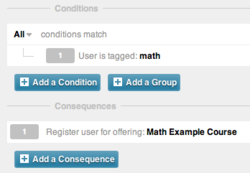
Online training software leader, DigitalChalk announced today it's release of the winter 2012 "Newton" edition to it's Cloud-based training software as a service (SaaS) platform. This latest release includes features for both the professional trainers selling courses online as well as the Enterprise accounts. Current Professional and Business account customers have full access to the shopping cart discount features. Enterprise accounts now have an advanced rules engine for course registration.
The discount features introduced for Professional and Business accounts include options for course providers to offer coupon codes, combination course bundles and even advanced user matching options. Matching options only allow discounts to apply if the user meets criteria such as an email domain or geographic location match. Training providers can also create registration codes for bulk sales to business clients.
With the introduction of Enterprise accounts, DigitalChalk now provides advanced course delivery, tracking and reporting features along with full single sign-on capabilities to integrate the Cloud-based training services into corporate networks. This release includes an advanced course registration rules engine that allows training managers to set up rules to assign training courses to audiences based on geography, user rules, user profile data or keyword matching.
"The Enterprise edition released this year has had significant traction for both current clients and new customers who need to rapidly roll out online courses" said Tony McCune, VP Sales. "Clients now routinely sign up, publish courses and deliver training to thousands or more employees in less than a month. With over 2,000 client organizations and nearly 6,000 courses being offered, DigitalChalk has become the clear leader in Cloud-based e-learning," said McCune.
About DigitalChalk
DigitalChalk was founded in 2005 and is headquartered in Asheville, NC. The SaaS training platform is available on a per-delivery fee basis for training professionals selling courses or a per-user basis for Business and Enterprise accounts. DigitalChalk is a full-service e-learning platform with course authoring, delivery and reporting included. DigitalChalk is the first and only online platform to provide HDLearn technology for video streaming capabilities that include tracking, progress control and reporting in a video lesson.
DigitalChalk was founded in 2005 and is headquartered in Asheville, NC. The SaaS training platform is available on a per-delivery fee basis for training professionals selling courses or a per-user basis for Business and Enterprise accounts. DigitalChalk is a full-service e-learning platform with course authoring, delivery and reporting included. DigitalChalk is the first and only online platform to provide HDLearn technology for video streaming capabilities that include tracking, progress control and reporting in a video lesson.
Subscribe to:
Posts (Atom)